


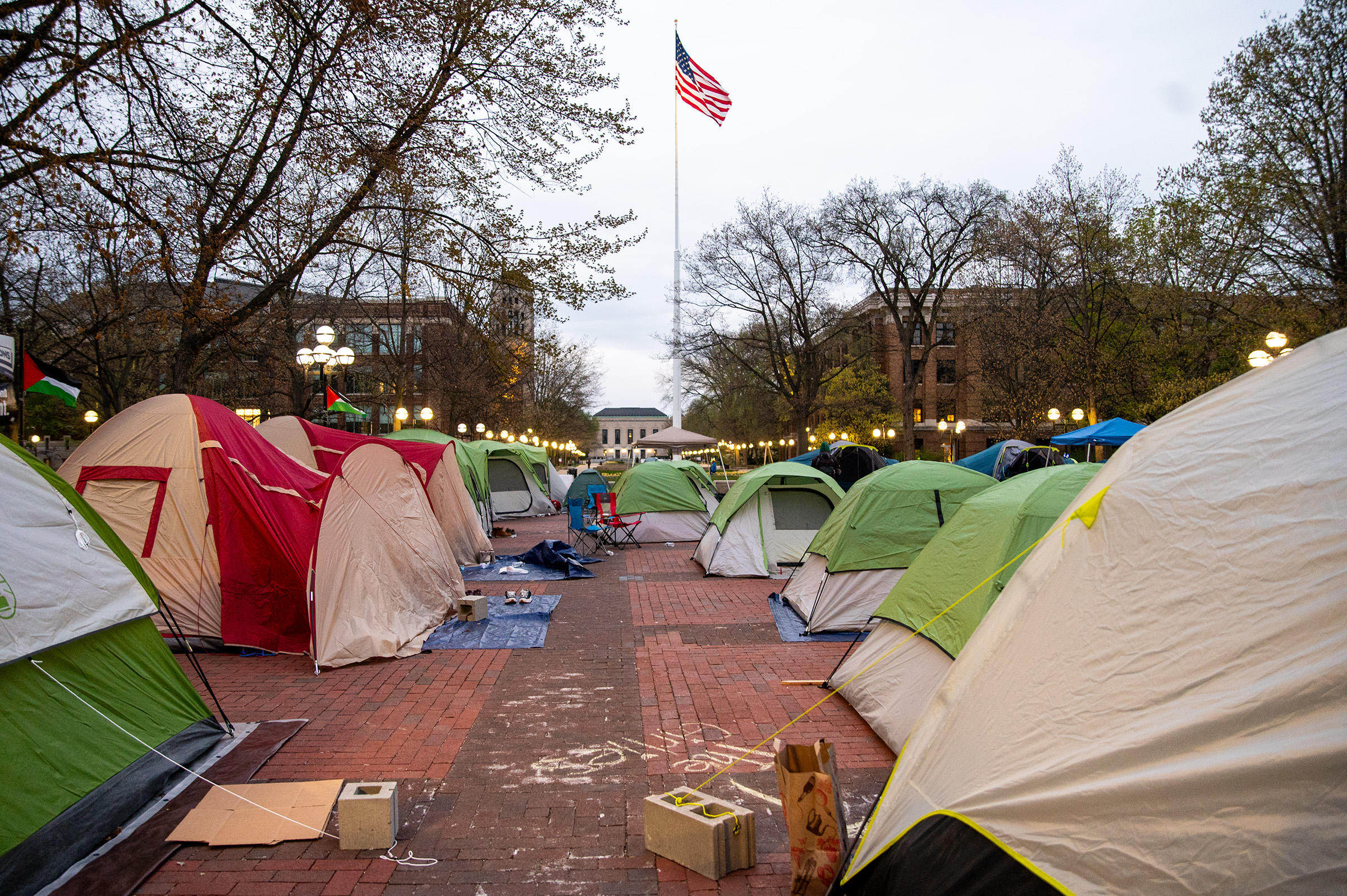
Monday
4:00 p.m.
By Christina Zhang

At 4:00 p.m., organizers hold a rally calling on the University to divest from companies profiting off of Israel’s military campaign in Gaza. The rally features four speakers, including SAFE president Salma Hamamy, Murad Idris, associate political science professor and two student activists.
Around a dozen pro-Israel students hold Israeli flags on the northwest corner of the Diag. Police officers from the Division of Public Safety and Security as well as Michigan State Police stand outside of Mason Hall watching the rally, but do not engage with students.
Speakers deliver their remarks from in front of the Hatcher Graduate Library. Hamamy speaks first and says living in the encampment is a way for protesters to call attention to living conditions in Gaza. Since the beginning of Israel’s military campaign in Gaza, residents have been subjected to increasingly poor living conditions and food shortages.
“As student organizers, we have sacrificed our time and our sleep,” Hamamy said. “But one thing we tend to not sacrifice very often is our comfort, and this is allowing us to experience another level of our privilege … to be living here with a roof over our heads, have easy access to bathrooms, food, water, heat. We are stripping ourselves of those right now, and that is entirely pale compared to what the people of Gaza are going through.”
The rally ends at 4:30 p.m. Some attendees leave while others join organizers on the Diag and chant various pro-Palestinian chants, including “Fund our education, not the occupation,” “Israel bombs, U of M pays, how many kids did you kill today?” and “From the river to the sea, Palestine will be free.”
5:00 p.m.
By Christina Zhang

Julianne Yoon/Daily. Buy this photo.
By 5:00 p.m., many picketers hold Palestinian flags and signs reading “Michigan Strike for Gaza / No Class No Work No Business As Usual.” Picketers chant for the University to divest as they circle around the Diag, while drummers in the middle of the Diag match the rhythm of the chanting with their drumming. Some of the chants include “Screw your lines, screw your threats, we’ll disrupt ’til you divest,” “We want justice, you say how? End the siege on Gaza now” and “From the valley of the beast, hands off the Middle East.” At 5:38 p.m., an organizer thanks picketers and attendees for showing support for Palestine. The organizer reminds attendees to stay safe from both the police presence and pro-Israel counterprotesters, and asks picketers to stay for as long as they are able. The organizer also encourages picketers to change directions while circling the Diag.
The organizer’s announcements are met with cheers as picketers continue to circle the Diag to the beat of makeshift drums.
6:00 p.m.
By Rachel Mintz

At 6:10 p.m., about 50 U-M student protesters slow their chants and come to a halt in the center of the Diag. Organizers collect signs and hand out snacks to protesters, who sit in a circle around the block ‘M,’ covered by a sign reading “Apartheid Isn’t Kosher, Jews Demand Divestment.” Members of the Graduate Employees’ Organization lead a teach-in on Palestinian social movements, both on the U-M campus and in the West Bank and Gaza.
Amir Marshi, a member of both SAFE and GEO, speaks at the teach-in and says as someone who hails from Palestine, he has seen persecution of Palestinians in the West Bank and Gaza in person.
“We will win divestment, but we want to completely decolonize Palestine and these institutions of higher education — Israeli institutions of higher education — they’re institutions of higher colonization, dispossession, repression,” Marshi said. “We’re seeing students everywhere are being repressed right now in every single way.”
In an interview with The Daily, LSA junior Rachel Sajdak says she has been at the encampment on the Diag since early Monday morning and is participating in the sit-in as a way to bring light to the struggle of Palestinians living among violence and poor living conditions in Gaza.
“I decided to come today because it felt like an appropriate sacrifice of my personal comforts of living at home and being able to go to class and eat food without any sort of infraction,” Sajdak said. “The reality is that Palestinians in Gaza do not have that comfort, and we can use our voice here on campus to raise awareness for the liberation of Palestinians in Gaza and Palestinians everywhere.”
Around 6:50 p.m., the teach-in ends and students gather for a seder, a traditional meal to celebrate the first night of Passover, which commemorates the Jewish people’s exodus from enslavement in Egypt.
7:00 p.m.
By Rachel Mintz and Nadia Taeckens

As the seder goes on, multiple police officers and security guards remain outside the doors of Angell Hall, and several University police vehicles are parked behind the south entrance of the Graduate Library.
Approximately 40 of the 100 people on the Diag participate in the seder. While the U-M chapter of Jewish Voice for Peace leaders pass out parsley, referred to as karpas, and salt water, students speak about the significance of the ritual. The students share that the act of dipping the karpas in salt water represents the tears of the Jewish people while they were experiencing slavery in Egypt.
Participants recite prayers together, filling the increasingly chill air with words in Hebrew, and eat Maror and Charoset, traditional Passover meals, as organizers speak about both the traditional significance of the practice and how its meaning was changed by the violence in Gaza.
As the seder ends, one participant stands up to play “Mi Shebeirach” on the violin, a song seen as an expression of concern and an act of healing in the Jewish community.
8:00 p.m.
By Nadia Taeckens and Madi Hammond

After the seder, participants line up by a food station to receive dinner, including kosher options for Jewish protesters. As the sun begins to set behind Mason Hall, students spread out across the Diag, eating and talking.
Around 8:25 p.m., the Adhan, a call to prayer, begins. Students roll prayer mats out across the Diag and gather in front of the steps of the Graduate Library. When space on the mats runs out, some people spread their coats or keffiyehs on the brick. The Maghrib prayer, one of the five daily prayers that Muslims perform, begins at 8:35 p.m. with more than 50 people participating.
Shoes line the perimeter of the prayer area as students face toward the Ka’bah in Mecca. Students fill a corner of the Diag, bodies moving in unison through the Rakat, a cycle of prayer with set movements. By 8:50 p.m., the prayer is over and the prayer mats are rolled up.
9:00 p.m.
By Madi Hammond and Marissa Corsi

A nearly full moon illuminates the Diag as more students trickle into the area, carrying pillows, blankets and food. At 9:11 p.m., Hamamy announces that the organizers will be playing the movie “Tears of Gaza” on the stairs of the Graduate Library. “Tears of Gaza,” a Norwegian documentary on the Israeli blockade and attacks on the Gaza Strip in 2008 and 2009, uses footage from Palestinian photographers to tell the stories of civilians during the conflict. In an interview with The Daily, Hamamy said protest organizers chose the film to promote hope as the film portrays life after conflict in Gaza.
“Being able to see the (Palestinian) people after overcoming what has happened in 2008 can give us a sense of hope and prosperity for what is soon to come hopefully after 2024, hopefully just seeing the steadfastness of the Palestinians in Gaza and that they are a people who desire to live and will continue to do so on all terms and levels,” Hamamy said. “That’s what this movie is about. (We’re) just trying to share that reflection with everybody here as a sense of hope as we engage in this encampment for the day.”
As the movie continues, two DPSS vehicles arrive and park behind the flagpole. One parks by the Samuel T. Dana Building.
10:00 p.m.
By Emma Lapp

As the night goes on, a continuous flow of students and Ann Arbor community members stop in the Diag to get a glimpse of the encampment.
Around 10:15 p.m., a meeting is called on the block ‘M’ by protest organizers for anyone spending the night or on night watch. Organizers explain logistics for the night, such as what to do in case of a medical emergency or who to go to if someone needs warmer sleeping bags. Organizers also inform protesters on how to react if approached by the police or the media.
Organizers advise protesters to read the body language of police officers if approached and to direct any questions to the police liaisons at the protest. The organizers also advise protesters to remain anonymous if approached by any media.
11:00 p.m.
By Sneha Dhandapani and Miles Anderson

As the clock strikes 11:00 p.m., five student protesters hang a sign from the light posts at the edge of the Diag facing Mason Hall reading “Regents, We Demand Divestment.”
In preparation for the night, students brush their teeth, bring audio and camping equipment into the tents and restock the snack table. As they work, conversation carries into the night. Protesters share their experiences from the day and speak about their plans to keep watch overnight. Trash cans at the corner of the Diag begin to overflow with wrappers and papers.
A screen on the steps of the Graduate Library plays videos of violence in Gaza. At 11:30 p.m., the videos stop and the screen is put aside. From afar, protestors see one DPSS car replace another just past the Diag’s flagpole.
Tuesday
12:00 a.m.
By Sneha Dhandapani and Miles Anderson

The Diag quiets just after midnight as the majority of protesters move into the tents to rest for the night. About 20 students sit on the Graduate Library steps, and 20 more are scattered across the Diag. Some sit around tables playing cards amid laughs and conversation. A few sit outside their tents, their faces illuminated by a laptop in preparation for finals week. Organizers make rounds offering snacks to those still awake. At 12:40 a.m., one protester runs toward a group of students near the block ‘M’ with two boxes of fresh cookies.
Over the course of the hour, student protesters, who were once spread across the Diag, huddle closer to the block ‘M.’ At about 12:40 a.m., one DPSS car changes out for another that has been sitting outside the Dana Building.
1:00 a.m.
By Astrid Code and Audrey Shabelski

While most protesters have gone to sleep, some students sit in lawn chairs outside the tents talking with each other and keeping watch around the perimeter of the encampment. Only one student still remains on the steps of the Graduate Library, charging their laptop. Soft laughter can be heard from inside some of the bigger tents.
Three legal observers sporting neon green hats sit near Ingalls Mall. The observers, who requested to remain anonymous, state that they are from the National Lawyers Guild Detroit Chapter and are present to ensure that the police do not interfere with protesters’ rights when protesting. The members say the group has been observing the protest in shifts since Monday afternoon. Two police cars sit near the Diag while two police officers monitor the encampment from their vantage point outside the Shapiro Undergraduate Library. By 1:30 a.m., most students have gone to sleep, and the Diag becomes quiet.
2:00 a.m.
By Samantha Rich and Mary Corey

Activity on the Diag has mostly stopped, with low chatter, laughs and quiet music coming from a few of the tents. Students shuffle in and out of a large tent in front of the steps of the Graduate Library, grabbing more blankets and padding before zipping up their tents for the night. Protesters’ shoes lie in piles outside the entrances of their tents, whose walls rustle occasionally from the wind or from movement inside.
Students sit in small groups outside and line the edges of the encampment — some stay put while others take periodic laps around the area. One pair of students does their homework on the Graduate Library steps and another pair sits on chairs at the corner closest to the Kinesiology Building. A small group of students also stands and talks quietly in a circle on the grass surrounding the Diag. Another group sits on the concrete benches at the back.
3:00 a.m.
By Samantha Rich and Mary Corey

The little movement throughout the Diag has mostly settled down as most protesters retire to their tents for the night. The occasional student coming back from late-night studying passes through the encampment, usually going around to sidestep the center of the Diag where the tents are pitched.
Even in the middle of the night, there are about three to five protesters walking around or sitting outside the Diag at any given time, presumably keeping watch while others sleep. Most of these protesters have keffiyehs on over their coats to keep out the brisk breeze. As the night progresses, the encampment is never completely still or silent. The first aid tent remains unzipped, although empty, and the supply table is still stocked with food and water.
4:00 a.m.
By Samantha Rich

While the Diag remains mostly noiseless, birds begin chirping in nearby trees: the encampment’s second day has begun. The small groups of people surrounding the Diag have mostly switched out, with new faces checking in on protesters and surveying the site. Two people stand at the back of the Diag, talking quietly, while a few at a time walk around the perimeter and among the tents. While passersby have crossed the Diag on their way to or from a late-night study session for the past few hours, almost no one is walking through anymore.
5:00 a.m.
By Nadia Taeckens and Emma Lapp

Most of the protesters remain sleeping in the more than 25 tents that fill the Diag, but a few begin to awaken, standing or sitting around the perimeter of the encampment to keep watch. Not many people are passing through the Diag, but two students who were not camping stop by briefly to check on friends.
Around 5:35 a.m., a few men begin moving a tarp to the corner of the Diag kept clear in preparation for Fajr prayer, which Muslims complete between the start of dawn and sunrise. A few prayer mats appear as well, and gradually, a small group of people awaken and go to the mats to pray.
6:00 a.m.
By Nadia Taeckens and Emma Lapp

By 6:00 a.m., those praying are finished with Fajr, and the tarps and prayer mats are put away. A few students make adjustments to their tent, but much of the camp remains still.
As the sun starts to rise around 6:30, more people start to get up and prepare for the day. Runners and cyclists go by as campus wakes up around the encampment. A few participants take to the steps of the Graduate Library to photograph the encampment under the slowly lightening sky.
7:00 a.m.
By Matthew Shanbom

At 7:00 a.m., streetlights across campus turn off, signaling the start of the morning. Some students begin to wake up, but the camp remains mostly asleep.
This hour is marked by preparation for incoming rain. The protesters who have already woken up walk around the camp encouraging sleeping protesters to bring their shoes inside the tents. This group also brings loose pieces of furniture and food inside the main tent, which is covered by an extra tarp. After this preparation, the rain appears to miss campus, saving the encampment from an early environmental obstacle.
8:00 a.m.
By Matthew Shanbom

At 8:00 a.m., the doors to the Graduate Library unlock, marking the start of the academic day. Students walk across the Diag as classes start for the day and campus begins to reopen. As the morning rolls on, DPSS presence slowly begins to ramp up as several groups of officers position themselves on the outskirts of the Diag. Throughout the hour, more students wake up and converse with each other.
9:00 a.m.
By Rachel Mintz

Phone alarms ring and tents are unzipped as protesters begin to wake up across the camp. Just after 9:00 a.m., organizers start passing out snacks including breakfast muffins, granola bars and oranges.
Some students passing through the Diag snap pictures on their phones as they move around and through the encampment, where more than 25 tents are still set up. Organizers set up foldable chairs around the block ‘M,’ and a few students sit down to enjoy a bagel and hot coffee from Tim Hortons brought by others at 9:30 a.m.
DPSS officers bike around the Diag while other officers in civilian clothes monitor the encampment on foot. Some of the attendees make their way out of tents with backpacks on and head to class.
10:00 a.m.
By Samantha Rich

As some students begin to leave for their first classes of the day, organizers have set up a check-in and check-out system for those living in the encampment. Two volunteers leave to pick up a delivery of additional supplies, and one person drops off a box of snacks as they cross through the Diag.
While some organizers meet around a table to discuss the upcoming day, others enjoy coffee and breakfast from the snack table set up near the block ‘M’ and stand or sit in small circles, chatting or reading.
Two individuals — one wearing a sweatshirt that reads “Am Yisrael Chai,” or, “The people of Israel live” — circle the Diag, taking pictures of protesters on their cell phones.
Protesters begin preparing the tents for anticipated rain and stronger winds, tightening the rain tarps and weighing the tents down with additional cinder blocks. Within minutes, a short burst of heavy rain begins before lightening into a drizzle.
11:00 a.m.
By Samantha Rich and Astrid Code

The light rain continues for another half hour before clearing up. Some protesters remain inside their tents while others gather in the center of the Diag and talk among themselves. As students continue to pass by the encampment to and from the final day of classes, two new legal observers walk around the perimeter of the encampment wearing bright green caps.
As the wind picks up, students in the center of the encampment attempt to set up a larger tarp over an open tent canopy. Volunteers empty the trash cans that surround the Diag, which have started to overflow throughout the night with packaging from their food and supplies.
12:00 p.m.
By Astrid Code and Marissa Corsi

At 12:00 p.m., TAHRIR Coalition organizers call a meeting, and about 50 campers gather around the block ‘M’ in folding chairs. Protesters offer suggestions for more organization within the camp, asking for a more official volunteering process and a communal reflection area. As additional supplies, including tent canopies and water, are brought into the Diag, camp leaders explain changes to the layout of the encampment. Specific tents are set aside for supplies, holding official media interviews and checking in and out of camp. The leaders also remind students that the encampment is a part of a larger movement in support of Gaza and say they should be focusing their attention on Palestine, not the encampment itself.
Meanwhile, WXYZ Channel 7 Detroit sets up video and audio recording equipment on the corner of the Diag and begins to interview a student activist in a clear poncho with a keffiyeh obscuring their face. During the meeting, a few onlookers approach to take pictures of the group. A handful of protesters stand to block their view, and others continue to offer face masks to shield identities from the media.
During the meeting, YouTube content creator Hayden Rhodea begins to approach campers with a GoPro and a microphone, repeatedly asking them to condemn the Islamist militant group Hamas. One of the camp leaders announces that students should not respond to him and instead direct media to organizers to set up official interviews.
As the meeting ends and protesters begin to disperse, two police officers on bicycles ride through the edges of the camp. A cluster of officers stands on one of the pathways across from the encampment, talking, while others on bikes park themselves in front of the doors to Mason Hall.
1:00 p.m.
By Emma Lapp and Audrey Shabelski

As the day continues, energy starts to build on the Diag, with student activists consistently moving around the encampment. Protesters write phrases in chalk such as “Resist genocide” and “We disrupt until you divest” on the ground. About 40 protesters gather under a tent on the block ‘M’ to eat lunch that has been donated throughout the past day.
Organizers and volunteers set up two additional tents in the middle of the Diag to allow for more people from the community to join the encampment, despite potential rain and wind.
An organizer, who requested to remain anonymous for fear of being doxxed, said in an interview with The Daily the tents are meant to serve many purposes during the encampment. In addition to helping ensure the safety and well-being of the protesters, they are also for educational and reflective purposes as the conflict and protests continue.
For most of the hour, Rhodea moves around the Diag with his GoPro and continues to ask protesters to condemn Hamas. Protesters consistently refuse to respond to what he is saying. Camp leaders stand behind Rhodea holding their fingers up to their mouths, signaling the protesters to not respond.
A student not participating in the encampment, who has requested to be anonymous for fear of being doxxed, says they are disappointed to not see a bigger presence of Jewish students counterprotesting at the encampment. They mention how they typically try to avoid the Diag when pro-Palestine protests are happening.
2:00 p.m.
By Ji Hoon Choi and Audrey Shabelski

Even through the drizzle of rain, students gather under the tents at the center of the encampment. Underneath one of the tents lies percussion instruments where students drum along with chants such as “Ono, Ono you can’t hide, you are funding genocide” and “From Palestine to Mexico, these border walls have got to go.”
While they practice their chants, Rhodea returns. He interrupts by asking more questions about Hamas, but the student protesters continue to drum and ignore him. Organizers tell The Daily Rhodea has a record of doxing attendees of pro-Palestine protests. Organizers then continue handing out masks to help protect the identities of the protesters.
Around 2:20 p.m., Rhodea is still walking around trying to interview the protesters, as protesters continue trying to get him out of the Diag. There was a group prayer arranged for Dhuhr prayer and the drumming continues while the group tries to pray. After Rhodea moves on from the Diag, he goes to the students praying and tries to ask them questions about Hamas. Participants try to shield the students praying by holding up their scarves and keffiyehs in front of Rhodea’s camera. Four police officers arrive to observe the occurrence.
The drumming and the attempts to get rid of Rhodea continue for the rest of the hour.
3:00 p.m.
By Rachel Mintz and Ji Hoon Choi

At the center of the Diag, U-M student protesters set up tents to shield themselves from the light drizzle of rain. Some protesters sit beneath the large, red tents near the block ‘M’ in foldable chairs, completing their homework and studying while other protesters eat lunch.
In front of the sign stating “Long live the Intifada” on one corner of the Diag, a group of about 10 U-M students holds up the Israeli flag. LSA junior Jack Landstein, vice president of engagement at Michigan Hillel, is one of the students present in the group. With an Israeli flag draped around his shoulders, Landstein says he came to the protest around 3:00 p.m. to show that there is a diversity of opinions on the U-M campus regarding the Israeli occupation in the West Bank and Gaza.
“We came out here just so Jewish students know that there are Jewish students here supporting them,” Landstein said. “Since we’ve been here for the last 30-ish minutes today, we’ve had a number of students look to us and say thank you and smile. That’s the type of support our students need on this campus currently.”
Landstein says as a Jewish student on the U-M campus, he feels the University is not doing enough to protect students from antisemitism.
“We look for the protection of our students, that’s the bottom line,” Landstein said. “I’d say in the long term, the University has to create some type of antisemitism training, (and) really decide on a definition of what antisemitism is so that they can protect their students because this type of alienation currently is just unacceptable and scary.”
LSA senior Nicole Wan, co-president of the U-M undergraduate chapter of the American Civil Liberties Union, says she has come to help the student protesters who are camping out on the Diag, often running to get things the protesters need while they stay on the Diag in protest. In an interview with The Daily, Wan speaks about what being part of the pro-Palestine protest means to her.
“I think the encampment represents that we’re willing to stand in solidarity with all other Students for Justice in Palestine chapters across the country honestly,” Wan said. “You’ve probably heard about the encampment at Columbia University, Yale, NYU now, at UNC, Washington University. I think these encampments are very similar to the solidarity encampments that happened in protest of the Vietnam War in the 1960s and also encampments that took place in the ’80s against South African apartheid.”
Wan says she believes protests like the sit-in on the Diag are important to create actual change.
“I think it’s a really good point to remember that when we have a disruption, it’s because protesters do not fear the consequences of their disruption as much as the injustice of the status quo,” Wan said.
The Michigan Daily News & Photo Staff can be reached at news@michigandaily.com and photo@michigandaily.com.
