


NEW YORK — While plenty of happy couples can trace their meet-cute moment to an online dating app, many others find the never-ending process of likes, swipes, taps and awkward DMs that go nowhere to be exhausting — leading to a phenomenon known as “dating app burnout.”

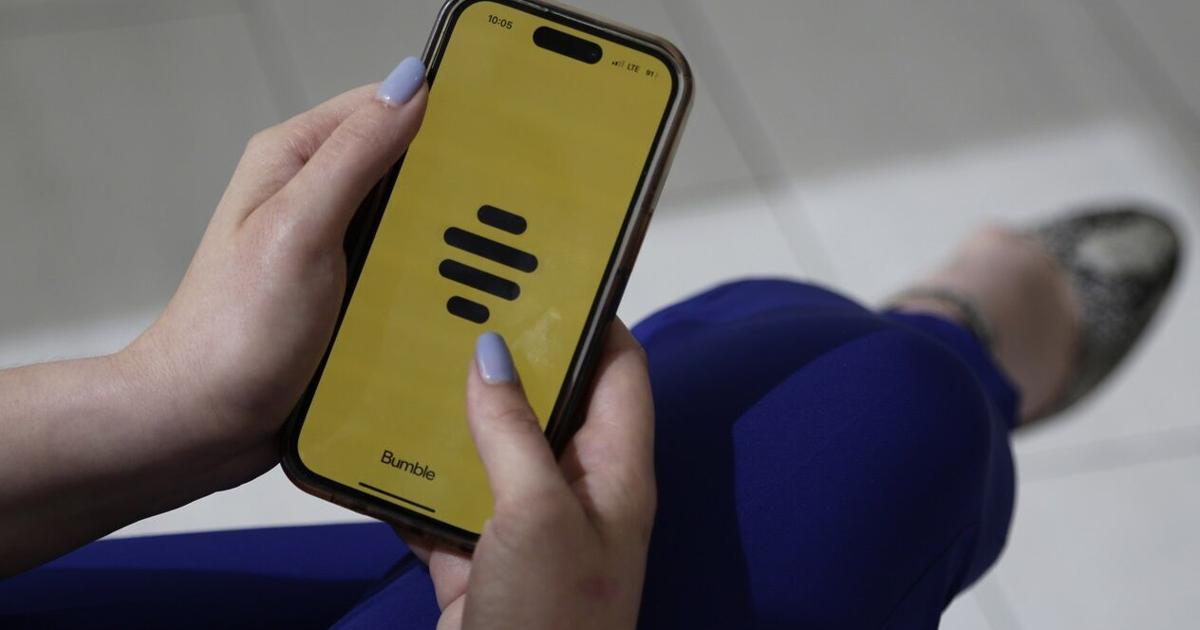
The dating app Bumble is shown on a smartphone Wednesday in New York. The never-ending process of likes, swipes, taps and awkward DMs that go nowhere to be exhausting, fueling a phenomenon known as “dating app burnout.”
That was the case for Marilyn Espitia, a 31-year-old freelance photo editor and photographer in California who first ventured into online dating in college, when she met her former partner and now father of her child on OkCupid.
Today she is single, and has been for about three years. While she’s still a “hopeless romantic” who plans to keep using these platforms — primarily Hinge — Espitia says she’ll get off an app or pause her profile when it becomes a little too much.
“It starts getting overwhelming,” Espitia said.
Licensed clinical psychologist Yasmine Saad says that about 3 out of every 4 people she works with use dating apps, and anywhere between 80 to 90% have expressed feeling similar fatigue or burnout as Espitia at some point.
People are also reading…
That’s due in part because success is never promised with online dating, regardless of whether you’re looking for a lifelong partner or casual fling.
“It’s a very difficult process for people because you invest a lot, then you receive little,” said Saad, founder and CEO of Madison Park Psychological Services in New York. “It triggers a lot of hopelessness and a lot of self-esteem issues.”
Kathryn Coduto, an assistant professor of media science at Boston University who has been studying online dating since 2016, says dating app burnout is probably as old as the apps themselves, noting that people had experienced fatigue with earlier desktop-dominant platforms like eHarmony or Match.com as well.
But these days, burnout may be intensified by the fact there’s an app for just about every part of our daily lives, and that constant connectivity can be too much. Pandemic-era “Zoom fatigue” has spilled over into other areas of tech consumption, Coduto said, and online dating isn’t immune.
That doesn’t mean dating apps are going away anytime soon. Research shows usage has remained relatively stable over recent years.
Pew Research Center said that 3 out of 10 U.S. adults reported ever using an online dating site or app as of July 2022 — identical to the share found in October 2019, months before COVID-19 impacted much of daily life, including dating habits.
While there was some uptick in new user downloads at the start of the pandemic, Coduto’s research found more of a spike in usage from those who already had dating apps and were spending more time on them during lockdowns. But those same lockdowns also limited in-person interactions, and the ripple effects are still being felt today.
“The pandemic increased loneliness,” Saad said. “But it also boosted the hopelessness … because even the apps were not meeting the needs of people for socialization.”
Others add that it can also become easy to forget there are people on the other side of those swipes and likes, making them feel dismissed while looking for connections.
“I think that sense of swiping endlessly absolutely plays into burnout,” Coduto said. “You’re treating people like a card deck because that’s what you’re looking at.”

Scores of updates that have recently emerged across various dating apps — from a new prompts option on Bumble, which shifts how the platform historically facilitated its “first move,” to Tinder’s “Matchmaker” feature allowing friends to recommend profiles for each other and Hinge’s tests of “your turn limits” to help fend off ghosting.
Yumei He, an assistant professor of management science at Tulane University’s A. B. Freeman School of Business who has also been studying online dating, said that hurtful experiences — such as being ghosted — can cause users to not trust a platform, or assume all future interactions there will end up the same way.
And of course, burnout doesn’t look the same for everyone. Experiences can range widely depending on gender, sexuality, race and ethnicity. Researchers have found that women and genderqueer individuals, for example, are more likely to face harassment than men, while racial and ethnic minorities are often fetishized in online dating spaces, or experience other discrimination resulting from sexual racism.
The trauma of experiencing discrimination and other abuse on a dating app can make it very difficult to stay on a platform or trust it again, Coduto said.
Companies are increasingly navigating ways to address all of this. Hinge, for example, in April launched “Hidden Words,” which allows its users to filter out words, phrases and emojis in their incoming likes and comments.
Gay dating and social networking app Grindr alerts users of potential safety threats in their area, which has been particularly critical for LGBTQ+ people in countries who may face police raids and other dangers, CEO George Arison said.
Scores of updates have recently emerged across various dating apps — from a new prompts option on Bumble, which shifts how the platform historically facilitated its “first move,” to Tinder’s “Matchmaker” feature allowing friends to recommend profiles for each other and Hinge’s tests of “your turn limits” to help fend off ghosting.
A handful of popular platforms, including Grindr and Tinder, say they’ve started integrating artificial intelligence to help identify potential harmful messages and other safety precautions. Some are also looking at AI possibilities such as using the technology to strengthen matching algorithms or offer users’ message prompts and date ideas.
Texting ex-partners, flirting online, staying on dating apps: Survey reveals most common infidelity habits—and why cheaters do them
Texting ex-partners, flirting online, staying on dating apps: Survey reveals most common infidelity habits—and why cheaters do them

With infidelity or extramarital affairs being the cause of 34% of divorces across the U.S, it seems that, unfortunately, cheating is a more common occurrence between partners than many of us would like to admit.
To understand just how prevalent cheating and infidelity are across the country, a Spokeo survey delved into how many people admit to being unfaithful to their other halves, and the main causes for affairs.
The research surveyed 1,158 U.S. adults to understand how many have been the victims and perpetrators of cheating, and where the most common places for temptation exist. The majority, 81.6%, of those surveyed were married, 10% were in a committed relationship and 5% were single and never married.
Key findings
- More than two in five of respondents surveyed (44.3%) have cheated on their partner.
- The most common reason given for cheating was ‘I liked the attention’ (22.1%).
- One in five (20.4%) cheated on their partner because they suspected their partner of cheating – the second most common reason.
- Among the survey respondents, nearly one in five have signed up for a dating app (18.7%) while in a relationship.
- Almost a quarter (23.7%) of respondents have gone through their partner’s phone and messages.
- Unfaithful partners are most likely to cheat with an ex-partner (20.9%), even if respondents are most tempted to cheat with their co-workers (38.4%).
- Over half (54.5%) believe a relationship can recover from cheating.

Over half of survey participants have been the victims of cheating

The survey results found that, shockingly, over two in five (44.3%) admit to cheating on an existing or previous partner, while half (50%) have been the victim of cheating or suspect they have been cheated on.
When asked what drove the participants to cheat on their partners, over one in five (22.1%) admitted it was due to liking the attention given by the third party, while 20.4% admitted their infidelity was due to them suspecting their partners were cheating or had cheated on them. A further 18.5% had an affair for revenge.
Other excuses provided by the respondents included immaturity and military deployment.
Participants offer various excuses for cheating

Almost one in five would define liking or responding to messages as cheating. What is defined as acceptable or unacceptable by partners differs among couples, and it is important to understand what the boundaries are for each relationship. To understand what would be considered as cheating, the survey provided respondents with a range of scenarios and asked them what would be classed as being unfaithful.
Nearly one in five respondents signed up for a dating app while in a relationship

Outside of physical acts, the research survey looked at other behaviors from both cheating or suspecting partners to understand what they find unacceptable, and how many admit to practicing these behaviors while being in a relationship.
Signing up to dating apps was the most frowned upon activity, with over a third (34.4%) claiming that it would be unacceptable from someone they were in a relationship with – however, a shocking 18.7% admitted to signing up to one while in a relationship.
Messaging someone on social media in a suggestive way was the second most unacceptable activity, with 32.4% of the 1,000 respondents finding this unacceptable. Unfortunately, almost one in five (19.6%) admit to sending messages on a social network.
While nearly one in five (19.4%) admit to not answering their phone and messages while out, 16.8% found this behavior unacceptable.
What behavior is acceptable to check a partner’s fidelity?

Almost a quarter of respondents have gone through their partner’s phone and messages
With the survey finding that cheating has affected half of couples, it is unsurprising that around a quarter (23.7%) have tried to find evidence of infidelity by going through their partner’s phone and messages – although this activity should be approached with caution, as 28% of those surveyed would find this unacceptable behavior.
Some suspecting partners have taken their suspicions one step further, with 14.2% using a GPS tracker to trace their partner, and 6.8% admit to employing a private detective to uncover infidelities. Looking up a partner online was the most accepted behavior, with 93% respondents claiming they would find this acceptable. Interestingly, just one in eight of the respondents (12.4%) admit to doing this.
Unfaithful partners are most likely to cheat with an ex partner

When those who cheated on their partner were asked who the third party was, one in five (20.9%) seemingly have gone back to the familiarity of an ex-partner. Work colleagues (18.4%) and someone they met online (18.3%) were also popular choices for those tempted into an affair.
Interestingly, work colleagues topped the poll for the group people were most tempted to cheat on their partner with. Since many U.S. adults spend around 40 hours a week with their colleagues, it is no surprise that emotional and, sometimes, physical connections are built.
Survey participants say they are most likely to cheat at a party

When the survey respondents were asked where the cheating took place, one in five (20.9%) were unfaithful at a party, with online chat rooms (19.6%) and at work (18.9%) also hotspots for cheating. People were most tempted to cheat while on holiday, with over a third (37.2%) admitting they have thought about cheating on a partner while away from home.
Over half of respondents (54.5%) believe a relationship can recover from cheating

When asked if they thought a relationship can recover from one of the partners cheating, over half (54.5%) believe that it is possible to get the partnership back on track. In fact, two in five (40.1%) claim that a relationship has survived cheating. Three in ten (31.7%) relationships couldn’t survive the trust being broken, while just under one in ten (9.4%) of partners didn’t find or hadn’t found out about the extramarital affairs.
However it seems that it is possible to forgive some behaviors more than others. Nearly two in five (38.1%) felt like they could forgive a partner messaging other people in a suggestive way, less than a third could forgive them if they signed up for a dating app (28.5%) or kissed someone else (28.3%). Unsurprisingly, having sex with another person was the behavior that most people felt a relationship couldn’t recover from, with over half (54.5%) believing a relationship can never recover from that.
Methodology
For this survey, Spokeo asked 1,158 Americans through Amazon’s survey platform in October 2023 about topics relating to relationships and infidelity. Of those surveyed, 81.6% were married, 10% were in a committed relationship and 5% were single and never married. Over three-quarters (77.8%) are parents.
The breakdown of the people surveyed was as follows:
Age Ranges:
- 18-24 – 4%
- 25-34 – 37%
- 35-44 – 44.7%
- 45-54 – 8.3%
- 55-64 – 4.2%
- 65+ – 1.6%
Gender:
- Female – 44%
- Male – 54.9%
- Non-binary – 0.9%
This story was produced by Spokeo and reviewed and distributed by Stacker Media.
